Vermiculite Insulation: How to Prevent It
Learn how to prevent vermiculite insulation hazards, when to test, and what abatement costs typically range from in USD.
Prevent vermiculite insulation hazards by leaving undisturbed material alone, scheduling professional testing, and hiring licensed abatement contractors if removal is needed.
- Typical bulk testing cost
- $50–$150 per sample
- Typical asbestos survey cost
- $300–$800
- Typical abatement cost
- $20–$50 per sq ft
- Typical pipe insulation removal
- $25–$75 per linear ft
- Typical floor tile removal
- $10–$25 per sq ft
Some links on this page are affiliate links.If you buy through them we may earn a commission at no extra cost to you. We do not accept payment for rankings. Read the full disclosure.
Vermiculite insulation punishes ordinary household instincts. It sits loose between attic joists, looks like coarse gravel, and invites scooping, vacuuming, bagging, and hauling away. Every one is the wrong move. Preventing a vermiculite problem is mostly a matter of leaving the material alone, testing it only when work requires it, and handing any disturbance to a licensed abatement contractor.
What Vermiculite Insulation Is
Vermiculite insulation is a lightweight, pebble-like loose-fill material made from expanded mica, poured into attics and wall cavities, and treated as asbestos-containing until laboratory analysis proves otherwise.
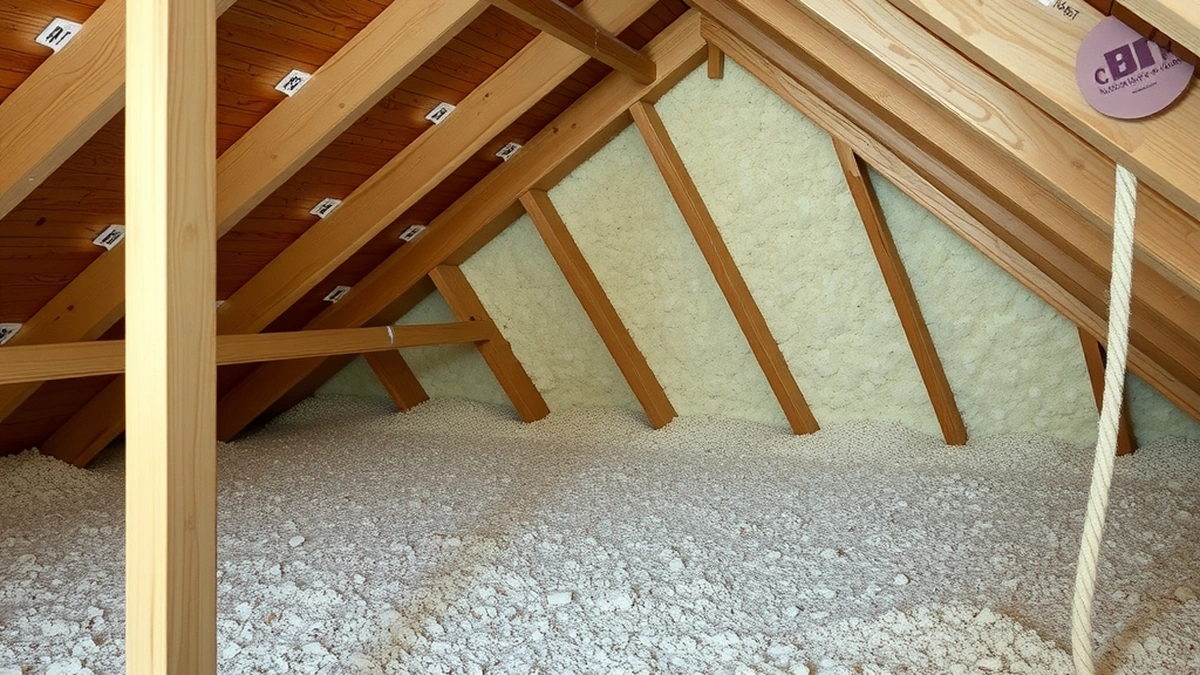
The mineral is heated until it expands into accordion-shaped flakes, which makes it absorbent, fire-resistant, and cheap. That combination made it popular in North American homes from the 1940s through the 1980s. In an attic it appears as a loose bed of gray, brown, or gold pellets between joists. Because it is loose, it shifts and escapes through the smallest gap, which is why it spreads contamination so effectively once disturbed.
Why Zonolite Still Matters
Much of the vermiculite sold in the United States as Zonolite came from a mine near Libby, Montana, that was contaminated with asbestos. The EPA advises homeowners to assume vermiculite insulation contains asbestos unless testing says otherwise.
That is not a claim that every bag of vermiculite is hazardous; it is a statement about what looking can tell you. Contaminated vermiculite is visually identical to clean vermiculite, so only laboratory analysis of samples collected by a qualified inspector can close the question.
Prevention Begins With Not Touching It
The lowest-risk strategy for intact vermiculite is to leave it where it is and keep it that way. Seal the attic hatch with weatherstripping so the material cannot sift into living space. Do not store boxes on it, because every footstep and dragged carton crushes pellets into dust. Do not sweep, shovel, or vacuum it with a household machine — a standard vacuum exhausts fine particles straight back into the air.
Renovation is the usual way people get into trouble. Running new electrical cable, installing a bathroom fan, blowing in additional insulation, or cutting a hatch into a ceiling can all disturb a vermiculite bed that has sat untouched for forty years. Before any of that work begins, treat the material as suspect and get it tested. Return ducts and attic leaks can also pull fibers into the rest of the house, so keep the attic separated from conditioned space while you decide what to do.
Testing: What It Costs and What It Proves
Testing answers one question — does this material contain asbestos — and it answers it only for the samples collected. A qualified inspector takes bulk samples using wet methods, then sends them to an accredited laboratory.
Costs are predictable. Bulk testing runs $50–$150 per sample; a typical attic assessment uses three to five samples. Four samples therefore cost 4 × $50 = $200 at the low end and 4 × $150 = $600 at the high end. A full asbestos survey, which includes visual inspection, sampling, and a written report, adds $300–$800 depending on property size. Combined pre-work cost lands around $500–$1,400.
Testing is cheap relative to what it prevents: uncontrolled disturbance can require HEPA vacuuming, sealed waste, air monitoring, and clearance testing across multiple rooms. For how the two services differ, see asbestos removal vs asbestos testing.
What Abatement Costs for a Vermiculite Attic
If testing is positive and the material must go, abatement is priced by area and complexity. General abatement runs $20–$50 per square foot. For a 500-square-foot attic, that is 500 × $20 = $10,000 at the low end, 500 × $35 = $17,500 at the midpoint, and 500 × $50 = $25,000 at the high end.
| Service | Typical range | 500 sq ft example |
|---|---|---|
| General abatement | $20–$50 per sq ft | $10,000–$25,000 |
| Pipe insulation removal | $25–$75 per linear ft | 20 ft = $500–$1,500 |
| Floor tile removal | $10–$25 per sq ft | 100 sq ft = $1,000–$2,500 |
| Encapsulation | $5–$15 per sq ft | $2,500–$7,500 |
| Bulk testing | $50–$150 per sample | 4 samples = $200–$600 |
| Asbestos survey | $300–$800 | $300–$800 |
Loose-fill attic work carries costs square footage does not capture: a sealed decontamination passage, negative air pressure in a space with no walls, bagging bulky material, and disposal at a permitted facility. Expect a vermiculite attic bid in the upper half of the range. Our vermiculite insulation cost guide breaks those variables out.
Encapsulation vs Removal for Vermiculite
Encapsulation is often described as the cheaper alternative, and on paper it is: 500 square feet at $5–$15 per square foot costs $2,500–$7,500 against $10,000–$25,000 for removal. At midpoints, $5,000 versus $17,500 — a $12,500 difference.
The comparison is misleading for loose-fill. Encapsulants are designed to bond to a solid substrate such as pipe wrap, duct board, or a textured ceiling. A bed of loose pellets has no surface to coat, and sealing it in place means building an enclosure — a rigid barrier or sealed membrane — which is a different scope entirely. Encapsulation may suit a bonded material elsewhere in the same house; for the vermiculite itself, a licensed contractor has to determine whether enclosure, removal, or management in place is appropriate.
A Five-Step Prevention Plan
- Assume the material contains asbestos. Do not probe it, scoop it, sweep it, or run a household vacuum over it.
- Control access. Seal the attic hatch, keep stored goods off the insulation, and stop anyone from walking through it.
- Test before you touch. Hire an accredited inspector before any renovation, wiring, plumbing, or insulation upgrade reaches the material.
- Get a written abatement scope if results are positive, naming containment, negative air, waste handling, and clearance testing.
- Keep the paperwork. File the survey, the work plan, the clearance results, and the disposal records for resale, insurance, and future contractors.
Steps three and four are the ones homeowners skip, and the ones that keep a manageable problem from becoming a whole-house cleanup.
Hiring, Documentation, and Disclosure
Asbestos abatement is regulated work. Contractors need EPA-accredited training and, in most states, a specific license, plus liability, workers’ compensation, and pollution coverage. Ask for the license number and check it yourself, then ask who performs clearance testing. An independent inspector is better than a crew signing off on its own work.
General contractors, insulation installers, and remediation companies without asbestos credentials should not open the attic. If someone offers to “just vacuum it out” or haul it away in a pickup, end the conversation. If the material is in a wall cavity rather than an open attic, the same rules apply with less room to maneuver — see our notes on vermiculite insulation repair and on pipe insulation prevention for adjacent materials that often appear in the same house.
Prevention is unglamorous: leave it alone, test before disturbance, hire licensed abatement when necessary, and keep the records. That sequence costs hundreds rather than tens of thousands, and it is the only one that keeps fibers out of the air you breathe.
Frequently asked questions
What is vermiculite insulation?
Vermiculite insulation is a lightweight, pebble-like material often found in attics; some brands, including Zonolite, were contaminated with asbestos during mining.
How do I know if my insulation contains asbestos?
You cannot confirm asbestos by sight alone; only laboratory analysis of collected samples by a qualified professional can determine if fibers are present.
Can I remove vermiculite insulation myself?
DIY removal of friable vermiculite insulation is strongly discouraged because disturbance can release airborne fibers; licensed abatement contractors should handle it.
How much does asbestos testing cost?
Bulk sampling typically ranges from $50 to $150 per sample, while a full property survey often runs between $300 and $800 depending on scope.
What does abatement cost per square foot?
Professional abatement generally ranges from $20 to $50 per square foot, though final pricing depends on containment needs, access, and local labor rates.
Is encapsulation an option for vermiculite insulation?
Encapsulation may cost roughly $5 to $15 per square foot and can seal material in place, but suitability depends on condition and a professional assessment.
Sources
Some links are affiliate links.If you buy through them we may earn a commission at no extra cost to you. We do not accept payment for rankings. Read the full disclosure.