Pipe Insulation: What a Fix Costs
What asbestos pipe insulation removal costs per linear foot, why friable lagging prices higher, and what fittings and access add to the bill.
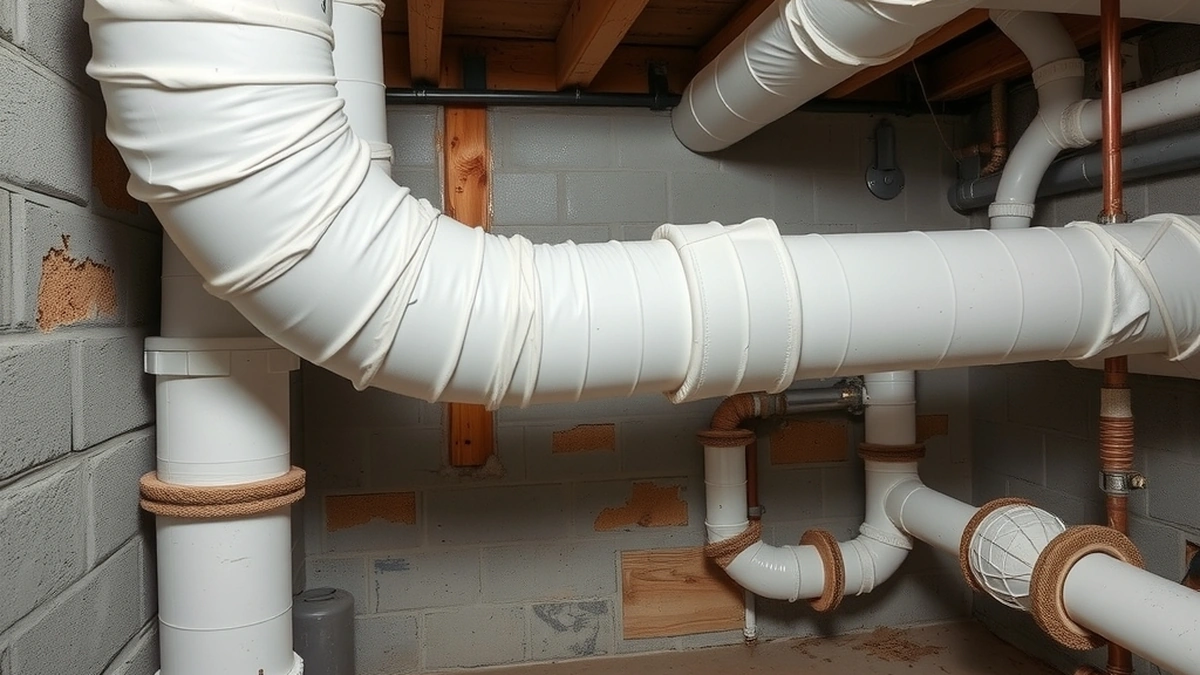
Asbestos pipe insulation removal costs $25 to $75 per linear foot, so a 60-foot run runs $1,500 to $4,500 before testing. It prices higher than floor tile because the lagging is friable and each fitting adds time and packaging.
- Removal rate
- $25 - $75 per linear ft
- Bulk testing
- $50 - $150 per sample
- General abatement
- $20 - $50 per sq ft
- Main risk factor
- Friable lagging and fittings
- Access
- Crawlspace and ceiling runs cost more
Some links on this page are affiliate links.If you buy through them we may earn a commission at no extra cost to you. We do not accept payment for rankings. Read the full disclosure.
Asbestos pipe insulation removal costs $25 to $75 per linear foot, so a 60-foot run runs $1,500 to $4,500 before testing. It prices above floor tile because the lagging is friable: it crumbles under hand pressure and releases fibers as soon as it is disturbed. Every elbow, valve and flange adds time.
Asbestos pipe insulation is the magnesia, calcium silicate or corrugated paper lagging wrapped around steam, hot water and heating pipes in older buildings, sometimes finished with a canvas or plaster jacket. The jacket looks solid until it is cut, and what is underneath is usually the most friable material in the building.
Why Pipes Cost More Per Unit
Friability is the reason. Floor tile is a bound matrix that has to be broken to release fibers. Pipe lagging is a chalky or fibrous material that releases them when it is touched, so the work is slower and the containment is stricter.
That changes the labor ratio. A crew working on pipe lagging spends more time wetting, sectioning, bagging and cleaning than a crew working on tile, and the waste is bulkier per foot of hazard. The $25 to $75 per linear foot range reflects that.
It also explains why a small damaged section is expensive. The containment, the negative air machine and the decontamination setup cost the same whether the run is 10 feet or 100 feet, so short runs carry a disproportionate share of fixed cost.
Priced by the Linear Foot
The rate is applied to the length of pipe, measured along the run including vertical drops. The table shows the arithmetic at both ends of the range.
| Run length | Low end at $25 | High end at $75 |
|---|---|---|
| 20 linear ft | 20 x $25 = $500 | 20 x $75 = $1,500 |
| 60 linear ft | 60 x $25 = $1,500 | 60 x $75 = $4,500 |
| 120 linear ft | 120 x $25 = $3,000 | 120 x $75 = $9,000 |
Add testing. Pipe lagging is usually sampled in two or three places because condition varies along the run, so two samples at $100 is $200 and a survey at $600 brings pre-work costs to $800.
Those are estimates. A straight run in an open basement sits near $25. A run threaded through joists, behind a finished ceiling, or wrapped around a boiler sits near $75.
What Fittings and Access Add
Straight pipe is the easy part. Elbows, tees, valves, flanges and hangers all interrupt the lagging, and each one has to be cut free, bagged and cleaned individually. Many contractors count fittings separately or add a percentage for a fitting-dense run.
Access is the other multiplier. A crawlspace with 18 inches of clearance is slower than a full-height mechanical room, and a run above a finished ceiling requires cutting an access hatch that then has to be restored.
Height matters too. A pipe at 12 feet needs staging; a pipe at 30 feet in a plant room needs a lift and a fall-protection plan.
Removal Against Encapsulation for Pipes
Encapsulation is rarely an option here. The comparison below explains why the rate gap is not really a choice for most pipe work.
| Route | Rate | Suitability | Result |
|---|---|---|---|
| Removal | $25 - $75 per linear ft | Friable lagging, damaged jacket, any condition | Material gone |
| Jacketing or enclosure | Priced per project | Sound lagging with an intact jacket | Material sealed behind a barrier |
| Encapsulation coating | $5 - $15 per sq ft | Poor fit for crumbly lagging | Not usually permitted |
A coating over crumbling lagging bridges a void and fails as soon as the pipe expands. That is why the cheap option on a ceiling does not transfer to a pipe run. Our comparison of abatement vs encapsulation explains the underlying rule.
What Pushes a Quote Up
Four things move a pipe job toward the top of the range. Fitting density is the first. Condition is the second: lagging that is already falling off is faster in one sense and far messier in another, and the cleanup is billable.
Access is the third, as above. The fourth is the pipe itself. If the line has to be drained, isolated or shut down for the work, the mechanical contractor’s time is a separate cost, and a steam system shutdown can affect the whole building.
The Sequence in Five Steps
- Sample the lagging at several points along the run, including any damaged section.
- Confirm the survey records the pipe size, the run length and the jacket type.
- Get quotes that separate straight runs, fittings and access work.
- Arrange any shutdown or drain-down with the mechanical contractor before the abatement crew arrives.
- Pass clearance testing, then have new insulation installed by a mechanical contractor.
Step four is the one that delays projects. An abatement crew that arrives to find a live steam line cannot start, and the standby time is billable.
Reading a Pipe Insulation Quote
A usable quote states the linear footage, the rate, the fitting count, the containment setup and the disposal destination. It should also state what happens if more asbestos-containing material is found once the jacket comes off, which happens often on old systems.
For the wider view, read asbestos pipe insulation removal and pipe insulation warning signs. For repair rather than removal, see pipe insulation repair. For the general abatement rate, asbestos removal cost puts it in context, and disposal cost explains the waste side.
Do not cut, wrap, tape or strip pipe lagging yourself, even to “check” it. That is exactly the action that releases the fibers, and the fix is a licensed abatement contractor with containment, not a hardware store jacket.
Frequently asked questions
How much does asbestos pipe insulation removal cost?
Removal runs $25 to $75 per linear foot, so a 100-foot run costs $2,500 to $7,500 before testing, permits and any access work.
Why is pipe insulation more expensive than floor tile?
The lagging is friable, meaning it crumbles and releases fibers easily, so it needs heavier containment, wet methods and more packaging per foot than non-friable tile.
Are pipe fittings charged separately?
Often yes. Elbows, valves, flanges and tees take longer than straight runs, and many contractors price them per fitting or as an added percentage.
Can pipe insulation be encapsulated instead of removed?
Rarely. Friable lagging usually cannot be sealed reliably, so removal is the standard route, though a contractor may jacket sound material in specific cases.
How long does a pipe insulation job take?
A short basement run is often one day, while a full mechanical room with multiple lines and fittings can take three to five working days.
Does the price include replacing the insulation?
No. Abatement covers removal and disposal. New pipe insulation, jacketing and any pipe repair are separate work by a mechanical contractor.
Sources
Some links are affiliate links.If you buy through them we may earn a commission at no extra cost to you. We do not accept payment for rankings. Read the full disclosure.