Asbestos Encapsulation Cost
What asbestos encapsulation costs per square foot, which materials qualify, and how the price compares with full abatement over time.
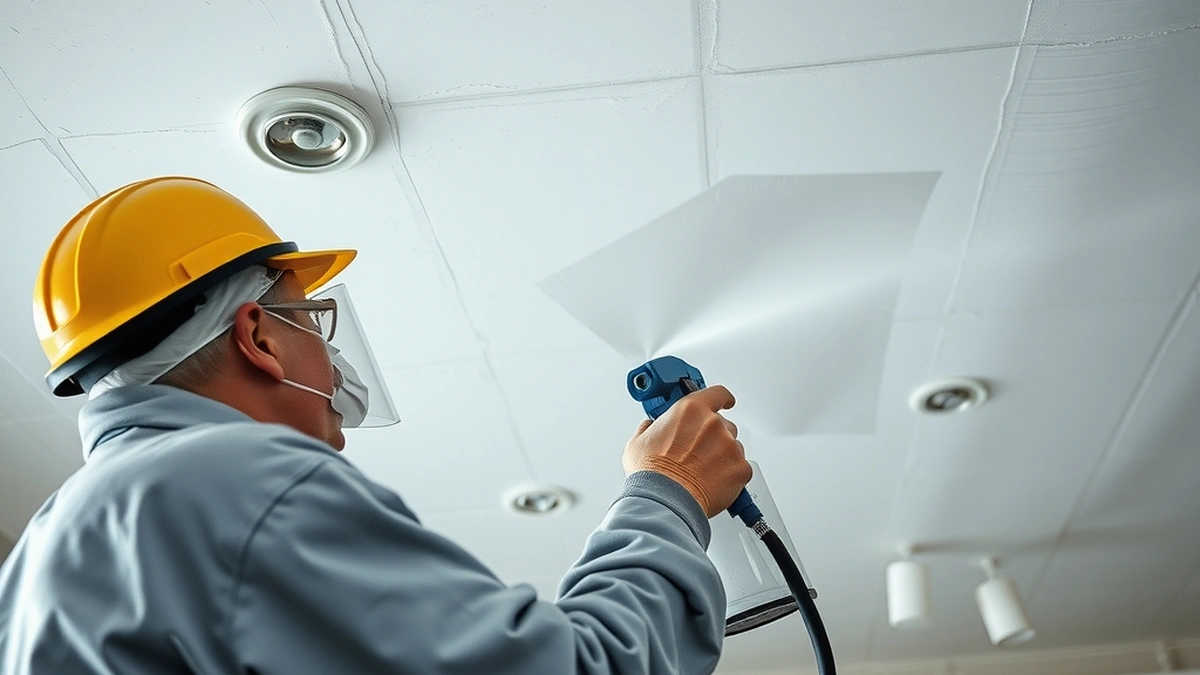
Asbestos encapsulation costs $5 to $15 per square foot, against $20 to $50 per square foot for full abatement. It seals sound material in place instead of removing it, so it is cheaper up front but leaves the asbestos in the building.
- Encapsulation
- $5 - $15 per sq ft
- Full abatement
- $20 - $50 per sq ft
- Saving against removal
- Roughly 70 - 85 percent at mid-range
- Best candidate
- Sound, accessible, non-friable material
- Disclosure
- Material stays and must be recorded
Some links on this page are affiliate links.If you buy through them we may earn a commission at no extra cost to you. We do not accept payment for rankings. Read the full disclosure.
Asbestos encapsulation costs $5 to $15 per square foot, compared with $20 to $50 per square foot for full abatement. It seals sound material in place with a coating that binds the fibers, so it is far cheaper than removal. It also leaves the asbestos in the building, which is the trade you are making.
Asbestos encapsulation is the application of a sealant or coating over asbestos-containing material to prevent fiber release without removing it. The material stays where it is, which is why the price is lower, the schedule is shorter and the disclosure obligations do not go away.
What Qualifies and What Does Not
Encapsulation works on material that is sound, accessible and not crumbling. Textured ceiling coatings, intact cement board, some floor tile and painted asbestos panels are the usual candidates. The coating has to bond to a stable surface, so anything flaking or water-damaged is a poor candidate.
Friable material is generally out. Pipe insulation, boiler lagging and sprayed fireproofing crumble under light pressure, and a coating over a crumbling substrate seals nothing. Most of that work is removal at $25 to $75 per linear foot for pipe insulation.
Some jurisdictions also restrict encapsulation in plenums, on surfaces subject to impact, or in areas scheduled for demolition. Those rules are local, and an accredited inspector’s report should state whether encapsulation is permitted for the specific material.
The Per-Square-Foot Price
At $5 to $15 per square foot, the arithmetic is straightforward and the range is wide.
| Area | Low end at $5 | High end at $15 |
|---|---|---|
| 200 sq ft | 200 x $5 = $1,000 | 200 x $15 = $3,000 |
| 400 sq ft | 400 x $5 = $2,000 | 400 x $15 = $6,000 |
| 800 sq ft | 800 x $5 = $4,000 | 800 x $15 = $12,000 |
Those are estimates before testing. Sampling at $50 to $150 per material and a survey at $300 to $800 come first, so a small job can carry $600 to $1,000 of assessment against a $2,000 coating price.
The low end assumes flat, clean, accessible material and a single coat. The high end assumes ceiling work, multiple coats, or a bridging sealant over a rough surface.
Encapsulation Against Removal, Costed
The comparison is where the decision gets made. The table uses the canonical rates and a 400-square-foot area.
| Measure | Encapsulation | Full abatement |
|---|---|---|
| Rate per sq ft | $5 - $15 | $20 - $50 |
| 400 sq ft total | $2,000 - $6,000 | $8,000 - $20,000 |
| Duration | Often 1 - 2 days | Several days plus clearance |
| Waste generated | Minimal | Regulated waste and manifests |
| Asbestos remains | Yes | No |
| Future demolition | Must be re-handled | Already gone |
At the midpoint, $10 per square foot against $35 per square foot, 400 square feet costs $4,000 encapsulated versus $14,000 removed. That is a $10,000 difference on one room, and it is real money. The encapsulation cost page covers how the price is built up line by line, and abatement vs encapsulation covers the decision in detail.
What Pushes the Price Up
Height and access are the first driver. Ceiling work needs scaffolding or staging, and a 12-foot ceiling costs more per square foot than a closet. Surface preparation is the second: sealing over dirt, grease or loose paint fails, so cleaning and stabilizing the substrate is billable work.
Coat thickness matters too. A bridging encapsulant applied thick enough to span a textured surface uses far more material than a thin penetrating sealer. Multiple coats on a porous substrate can double the material cost and add a day.
Finally, occupancy. Sealing a room means emptying it, sealing the door and running the job in isolation. Commercial work done after hours carries premium labor.
Getting a Quote in Four Steps
- Get the survey report and confirm the material is listed as sound and eligible for encapsulation.
- Ask which sealant type is proposed: penetrating, bridging, or a combination.
- Confirm the price includes surface preparation, containment and post-application inspection.
- Get the re-inspection interval in writing, because the coating needs checking.
Item four is often missing from quotes, and it is the one that determines the real ten-year cost.
The Maintenance Cost You Are Also Buying
Encapsulation is not a one-time expense. The coating needs inspection at intervals, and damaged areas need re-coating. Budget a few hundred dollars per inspection visit, plus the cost of touching up any damaged section at the same per-square-foot rate.
Over ten years, two inspections and one partial re-coat can add $1,000 to $2,500 to a $4,000 job. That still beats $14,000 for removal in most cases, but it narrows the gap. Our encapsulation maintenance guide lists what an inspection should check.
What Encapsulation Does Not Solve
It does not remove the hazard, so it does not remove the disclosure. It does not survive demolition, and it complicates renovation because any penetration through the coating has to be handled as an asbestos disturbance. It does not fix water damage, and a coating over a leaking pipe chase will fail.
It also does not make a friable material safe. If the inspector says the material is crumbling, encapsulation is not a cheaper removal; it is a delayed removal with an extra step.
When the Numbers Favor Removal
Choose removal when the material is friable, when a renovation will disturb it within a few years, when the area is small enough that the removal minimum is close to the encapsulation price, or when a sale is imminent and the buyer wants a clean report.
Choose encapsulation when the material is sound, the area is large, the space will not be renovated, and the coating can be inspected on schedule. For the removal side of the arithmetic, see asbestos removal cost and disposal cost. For the application process itself, encapsulation installation walks through what the crew does. In every case, the decision belongs to a licensed inspector and contractor, not to a homeowner with a roller.
Frequently asked questions
How much does asbestos encapsulation cost?
Encapsulation runs $5 to $15 per square foot, compared with $20 to $50 per square foot for full removal, so the saving is substantial but the material remains in place.
Is encapsulation cheaper than removal?
Yes, typically by a wide margin. At $10 per square foot against $35 per square foot, a 400-square-foot area costs $4,000 instead of $14,000.
Can all asbestos be encapsulated?
No. Friable, damaged or water-damaged material generally cannot be sealed, and some states restrict encapsulation in specific locations, so an inspector must confirm suitability.
Does encapsulation need to be disclosed at sale?
Yes. The material is still present, so it should be recorded and disclosed along with the encapsulation date and the inspection schedule.
How long does encapsulation last?
A sound coating can last many years, but it needs periodic inspection and re-coating where it is damaged, and it does not survive demolition or major renovation.
Is encapsulation allowed on pipe insulation?
Rarely. Most pipe insulation is friable and cannot be reliably sealed, so removal at $25 to $75 per linear foot is the usual route.
Sources
Some links are affiliate links.If you buy through them we may earn a commission at no extra cost to you. We do not accept payment for rankings. Read the full disclosure.